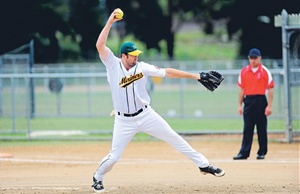
Is Adam Folkard "hiding" the ball? - (Photo by Melissa Adams)
Click logo to read original story
Editor’s Note: This story continues to receive attention in Australia and now New Zealand. Further clarification on the origin of the rule seems to be offered in this piece. In the box scores thus far, we’ve only seen notice of one illegal pitch being called on Juan Potolicchio – whose style is similar to Folkard’s in that he does not separate the hands until he is well off the board – but that doesn’t mean that more haven’t been called.
TONY SMITH – The Press
The world’s top men’s softball pitcher has withdrawn from the Australian team for the current international series in New Zealand because of “uncertainty” over a recent pitching rule change.
Adam Folkard twice shut out the Black Sox to pitch Australia to their first world championship title in Saskatoon, Canada. The Canberra native threw a no-hitter in a 5-0 final victory to deny New Zealand an unprecedented fourth consecutive world title.
The 23-year-old had earlier hurled Australia to a 7-0 win over New Zealand after conceding a solitary safe hit.
But Folkard pulled out of this week’s quadrangular tournament featuring the Black Sox, Argentina and two Australian teams.
A statement on Softball Australia’s website said the right-handed flame thrower had “chosen to withdraw due to the uncertainty surrounding the recent implementation of a pitching rule [by the International Softball Federation].
“Softball Australia has approached the International Softball Federation [ISF] requesting clarification of what constitutes a legal pitching action,” the statement said.
The Australian national body and Softball ACT (based in Canberra) have engaged an Australian Institute of Sport biomechanist to analyse their pitchers’ actions.
“Once we have received clarification from the ISF on the exact interpretation of the pitching rule we will be in a better position to determine our next course of action,” Softball Australia manager of high performance Julie Anderson said.
The rule changes were endorsed at the last International Softball Congress but Softball Australia voted against it and asked for their objection to be recorded.
“We are confident of a favourable response from the ISF,” said Anderson, who felt Australia’s pitchers would benefit “from a biomechanical analysis that captures what the naked eye can’t possibly see at a world-class level”.
Softball New Zealand pitching adviser Debbie Mygind was not aware why the Australians were concerned with the rule change which took effect in January and has been operative in New Zealand since March.
The new rules legalised leaping, allowing pitchers to have both feet off the ground while airborne – an innovation which has been welcomed by pitchers.
But the ISF now requires pitchers to separate their hands by the time they leave the pitching mat. Both hands must be separate by the time the back foot leaves the ground, thus preventing pitchers generating more momentum to step closer to the batter.
Mygind, who pitched New Zealand to the world women’s title in 1982, has been holding pitching rule workshops since March. She said she had delivered her presentation, via Skype, to the ISF’s chief umpire.
A pitching rule-change video available for viewing through the ISF’s website was compiled by an Australian umpire.
Editor’s Note: If anyone can find the video on the ISF website, please send us the link – we’ve looked, but they’ve done a great job of hiding it.
Video/powerpoint found on czech website (use google translate)
http://www.softball.cz/article.php?sid=1755&index=1&mode=&order=0
Juan threw a 3 hitter and struck out 12 against Australia gold in a 3-0 win for Argentina, so the new rule
does not seem to have an affect on his pitching.